In 2015, before I even moved here, I planned what I would do with the nearly blank-slate lot where the house sits. Nearly blank-slate because the existing plantings were comprised of invasive burning bushes all around the front porch, a scraggly silver maple in the front yard, and a single lilac bush ‘round back. I scheduled their removal and started planning for native replacements. At our local Greenview Nursery, on sale, were a witch hazel, a serviceberry, and two thornless Skyline honey locusts. Perfect for the landscape for a little bungalow. The honey locusts were planted in the parkway by the nursery, carefully placed to avoid the utilities in the relatively narrow strip and to frame the house, plenty of room between them. They wouldn’t get too big for the space or drop messy or dangerous fruit onto the sidewalk or the street.
I took care of these trees for ten years, fertilizing and pruning as needed. So what if the web worms came once in awhile. The resulting Baltimore Orioles that feasted on the worms were a real treat.
Derecho, Cicadas, Drought, Locust Borers
On June 29,2023, a storm with strong straight-line winds hit Springfield, toppling large trees and downing power lines. We were without power for five days when trees falling across alley power lines snapped poles. One of the now-20-foot-tall honey locusts was hit by a large tree limb from one of the mature tulip poplars across the street, with one limb of the honeylocust bent in half. At the time we trimmed it up and didn’t think too much about it.
Then in the summer of 2024, came not just one but two broods of periodical cicadas. https://nativeurban.garden/posts/periodical-cicadas-2024/ I’m not sure the cicadas did any damage to the honeylocusts – if any at all, it would have been to the thinner end branches. The weather throughout the midwest was dry in 2024, with significant parts of Illinois in drought status.
Spring 2025 came but the southernmost tree didn’t leaf out. The certified arborist from Greenview came out and diagnosed locusts borers, which are likely to infest trees that are stressed. I had the tree was cut down shortly after. The other honeylocusts, including a new but smaller Skyline planted in the parkway of the lot, were still healthy. The recommendation was for watering during dry spells and prophylactic treatment against borers. I treated both remaining trees with dormant oil spray early in 2026.
City Cuts Down Healthy Trees Without Warning
Imagine my surprise to glance out my front door April 2, 2026 to find City of Springfield workers cutting down the remaining large honeylocust tree in the parkway. No warning, no consultation. One of the two people cutting said, “The city owns the parkway, and we can do whatever we want.” He called the city arborist. The city arborist said to me, “The city owns the parkway, and we can do whatever we want. It was too close to the curb and would cause problems.” The ticket, which did have my actual address, indicated it was a maple tree.
PHOTOS HERE: TREE, STUMP W MEASUREMENT
The first cut
About three months prior, on January 9, 2026, the city also cut down a large mature tree directly across the street. At the time I talked to the Public Works people who cut it down, and they indicated that it was not diseased, as the ticket specified, but healthy. It did have poison ivy growing around the base, and my neighbor had asked for it to be trimmed up, but not to be cut down. A FOIA response confirmed that she had asked that it be trimmed. The large tree across the street didn’t need to be cut down – my neighbor did indeed request “needs trimmed back from the street”, but the whole tree was cut down. The request and work order are dated August 2025, before the Arborist started working for the city.
Talking to the City
The first person I texted was my City Council person, who was sympathetic and said she had noticed other trees being cut down in her neighborhood.
I sent an email to the Director of Public Works and the Mayor:
LETTER HERE
On April 7, I spoke with Director of Public Works David Fuchs, and he said the wrong tree was cut down. The work order said “South” instead of “North”. The Mayor approved the replacement of the tree with the same variety, assuming the underground utilities allow for it. It won’t be as large, of course. I was at least temporarily appeased.
Later that day, I submitted two FOIA requests, one for each tree, referencing the City code about protecting trees, CHAPTER 102. – URBAN FORESTRY/TREE PRESERVATION, particularly 102.40. – Protection of public property trees, shrubs and other plants. https://library.municode.com/il/springfield/codes/code_of_ordinances?nodeId=TITIXGERE_CH102URFOTRPR
I also submitted another FOIA, requesting a report of all trees cut down by the city since July 2025, which was denied — they wanted the actual addresses of every tree.
Insult, Injury
On April 10, the city ground out the stump – and also dug up/covered over a 3×4′ native planting of Antennaria neglecta (prairie pussytoes) and Sisyrinchium angustifolium (blue eyed grass). I managed to uncover and pot up four of the pussytoes, which had just gotten a toehold this past year. The blue eyed grass was beyond saving, but fortunately I had divided the blue-eyed grass last year to plant some in my rose garden, so I’ll have those to propagate from in future.
I wanted to see what the tree that was supposed to be cut down looked like, so I did a Google Maps search for 2016 N 4th St:
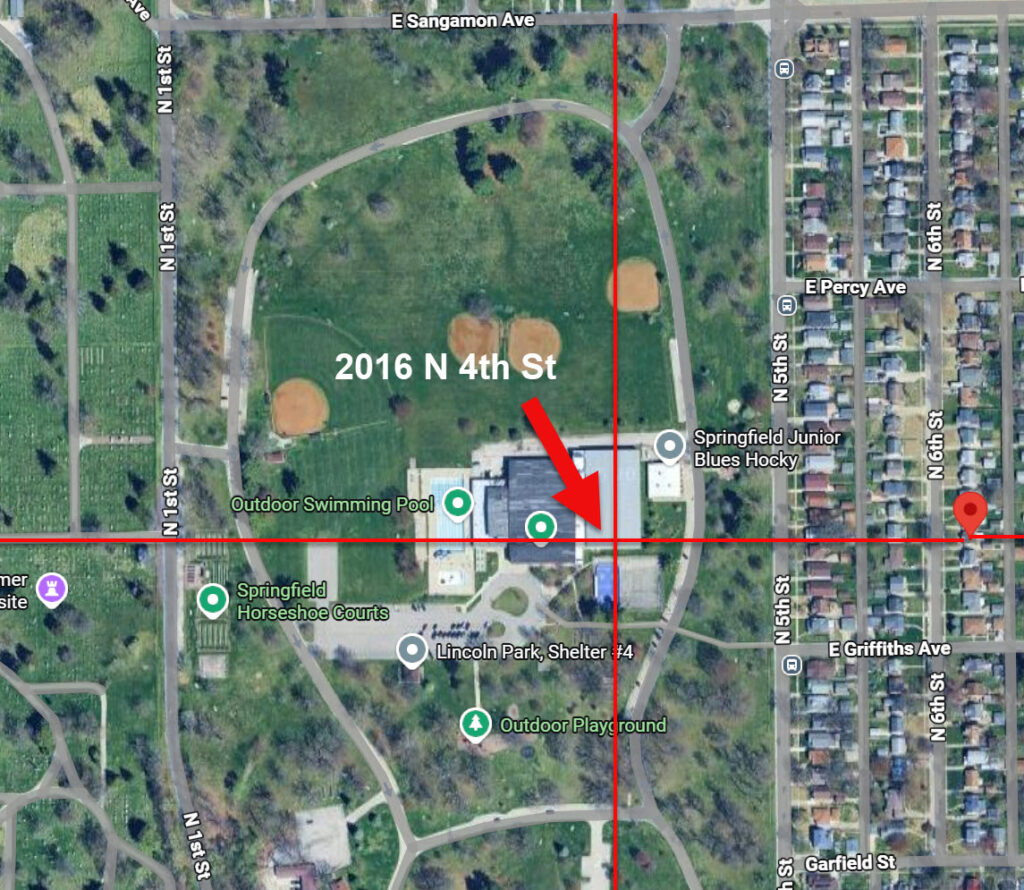
This is in the middle of Lincoln Park.
Why?
I still don’t know why my tree was cut down:
- Mistake? Wrong kind of tree?
- There are tens of thousands of honeylocust trees much closer to the curbs throughout the city. Will the city cut them all down?
- Is this a plan by the city to systematically reduce city expenditures in caring for trees in parkways?